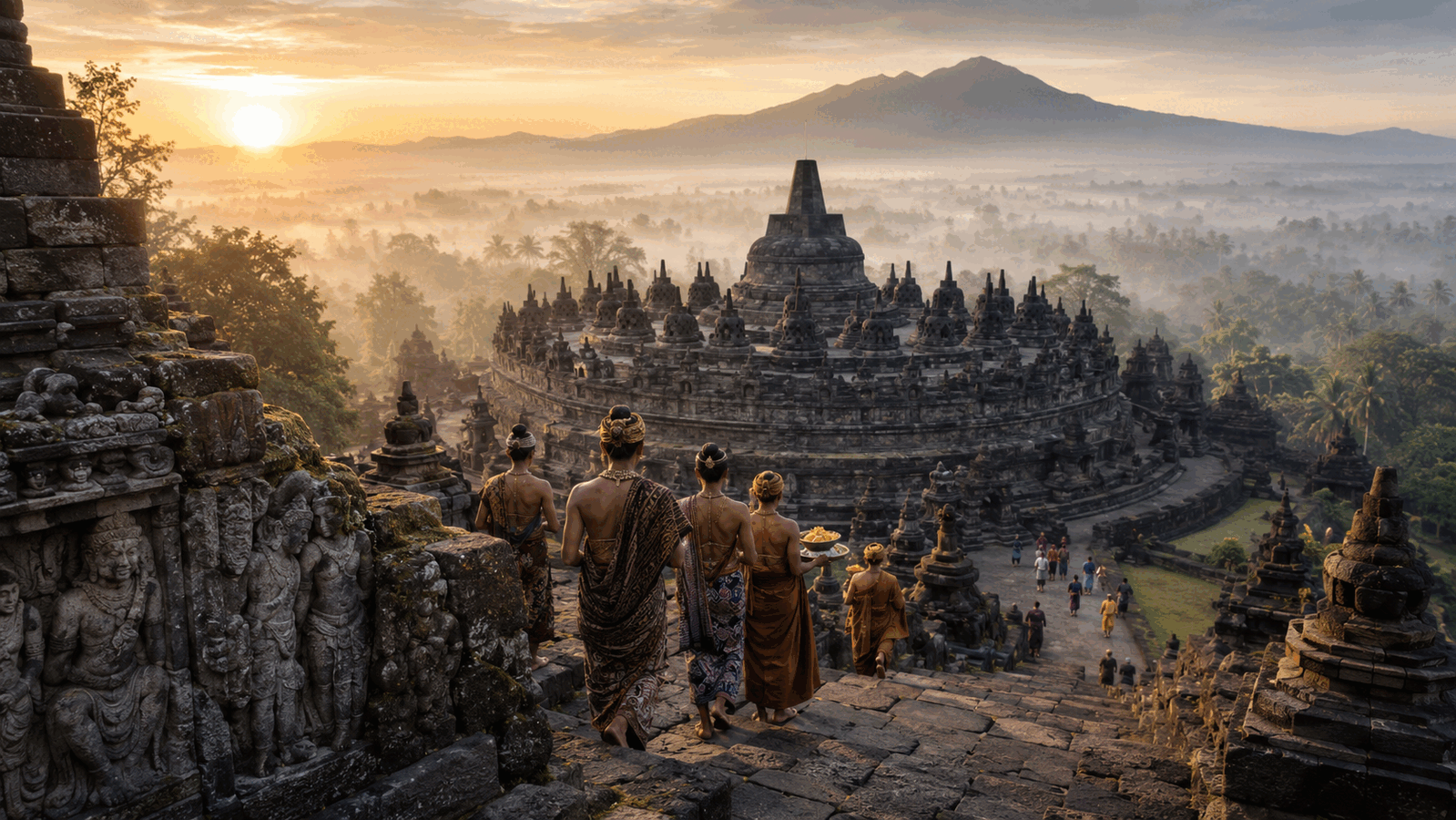
The Borobudur Temple Historical Timeline reveals the long journey of one of Indonesia’s most important cultural treasures. From its construction during the Sailendra Dynasty to its modern preservation, Borobudur reflects centuries of religious, architectural, and historical development.
Located in Central Java, Indonesia, Borobudur represents the achievements of ancient Javanese civilization. The temple has experienced periods of growth, abandonment, rediscovery, and restoration throughout its history.
8th Century: The Beginning of Borobudur Construction
The history of Borobudur began during the 8th century under the Sailendra Dynasty. Historians estimate that construction started around 750 CE during a period when Mahayana Buddhism flourished in Java.
The builders designed Borobudur as a sacred Buddhist monument. They created the temple to represent the spiritual journey toward enlightenment.
Millions of volcanic stone blocks were arranged to form terraces, stairways, stupas, and galleries. The structure followed Buddhist cosmology through three main levels: Kamadhatu, Rupadhatu, and Arupadhatu.
Visitors can discover more about this ancient monument through Borobudur Temple history, origins, rediscovery, restoration, and legacy.
9th Century: Completion and Buddhist Pilgrimage Center
By the early 9th century, Borobudur was likely completed during the reign of King Samaratungga. The monument became an important center for Buddhist activities in ancient Java.
Pilgrims visited Borobudur to meditate and learn Buddhist teachings. They followed a symbolic path by walking through the temple terraces.
The relief panels on the walls presented Buddhist stories and moral lessons. These carvings also showed aspects of ancient Javanese life.
10th–15th Century: Decline and Abandonment
After the decline of the Sailendra Dynasty, Java experienced significant political and religious changes. The center of power moved toward East Java, and Borobudur gradually lost its importance.
The temple was eventually abandoned as religious traditions changed. Volcanic activity, soil, and tropical vegetation covered parts of the structure over centuries.
Although Borobudur became hidden, local communities maintained knowledge about the ancient monument.
19th Century: Rediscovery of Borobudur
Borobudur returned to international attention in the early 19th century. In 1814, Sir Thomas Stamford Raffles received reports about a large ancient structure hidden in Central Java.
Raffles instructed H.C. Cornelius to investigate the site. The exploration revealed the impressive scale of Borobudur and encouraged further historical research.
Early documentation helped researchers understand the temple’s architecture and cultural significance.
20th Century: Restoration and Preservation
After rediscovery, experts identified many preservation challenges. Weather conditions and water damage threatened the stability of the monument.
Theodoor Van Erp led one of the earliest restoration projects between 1907 and 1911. His work focused on stabilizing the structure and documenting important architectural elements.
A larger restoration program was later conducted between 1975 and 1982. The Indonesian government worked with UNESCO to protect Borobudur from further deterioration.
21st Century: Borobudur as Global Heritage
Today, Borobudur stands as one of Indonesia’s most valuable heritage sites. UNESCO recognized the monument as a World Heritage Site in 1991.
Modern conservation efforts continue to protect the temple while allowing visitors to experience its historical value.
Travelers who want to explore this remarkable monument can join a Borobudur Temple tour to discover its architecture, history, and spiritual meaning.
Conclusion
The Borobudur Temple Historical Timeline shows the transformation of an ancient Buddhist monument through centuries of change. From its construction in the 8th century to modern conservation efforts, Borobudur remains a symbol of Indonesian heritage.
Understanding its timeline allows visitors to appreciate every terrace, relief, and stupa as part of a remarkable historical journey.